Project
growing minds
An educational game that encourages children to explore ecosystems, connect with nature and develop the skills to shape sustainable lifestyles in the future through play.
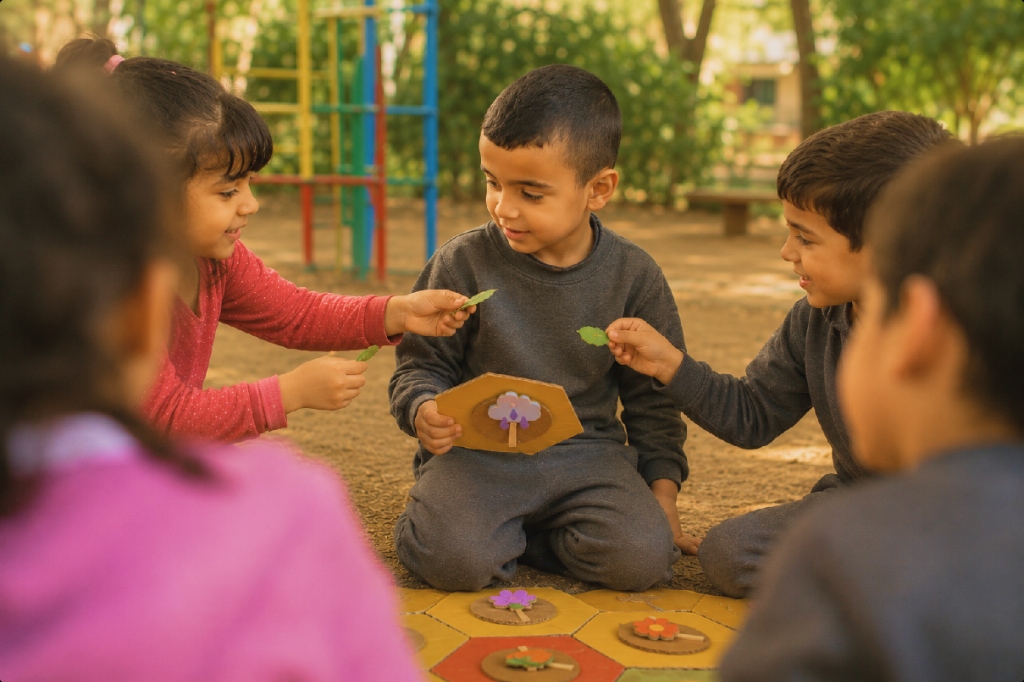
Growing Minds
A hands-on gameplay for children to interact with physically as well as digitally.
What it does
Players come together to build ecosystems in nature using plants, animals and water. Through play, they develop:
systems
Systems thinking.
adapting
Adaptability.
solving
Problem-solving.
together
Collaboration.
The game transforms ecological concepts into interactive, hands-on experiences, nurturing environmental awareness and empowering children to imagine sustainable futures.
Concept
Growing Minds invites children to discover the wonders of nature through play. By solving ecosystem challenges, players develop creativity, adaptability and problem-solving skills, blending fun with real-world learning.
How it works
Explore
Find an element in nature.
Build
Place it at the centre and connect related ecosystem tiles.
Discuss
Decide what belongs, what is missing and how the elements depend on one another.
Reflect
Connect the learning to nature in everyday life.
Building skills through play
Skills are not taught separately.
They emerge through gameplay
Growing Minds turns play into a dynamic learning tool. Children navigate ecosystems, respond to changing conditions and collaborate to solve challenges.
Systems thinking, through connections
Every move touches something else. The web is the lesson and children find it by pulling on it.
Adaptability, through shifting scenarios
Conditions change mid-game. The plan that worked last round stops working and has to be rebuilt.
Resilience, through trial and error
Failure is a move, not a verdict. Abstract ecological ideas become tangible, testable and meaningful.
From play to real-world impact
Growing Minds helps children see nature as an interconnected system and themselves as part of it.
Design process
Rooted in research
and iterative design
playtesting
Continuous playtesting with children, from the earliest rough prototypes onward.
educators
Feedback from educators, folded back into each iteration.
classrooms
Real-world classroom environments, tested across schools in Hungary and France.
Growing Minds was tested with children and educators in France and Hungary. Their feedback helped make the gameplay clearer, more collaborative and easier to use in classrooms.
In schools
Sessions in Grasse
and Budapest
Grasse, France
A morning with one class: hunting through the schoolyard with magnifying glasses, then moving inside to build the ecosystem out of tiles on the classroom floor.
Budapest, Hungary
The same game outdoors in winter coats: the board laid out across the schoolyard and then the grass, with two facilitators keeping it moving.
Cultural foundation
Growing Minds draws from perspectives across India, Turkey, Hungary and France. That diversity informs how the game approaches learning, play and ecological understanding.
The game
systems thinking
Colour-coded hexagonal tiles represent different ecosystem categories. With no fixed order or single correct answer, every ecosystem can grow and change through the children’s choices.
collaboration
Learning through play in collaboration: children recognise connections and make decisions together to build cycles in nature.
adaptable
The game features plants, animals and environmental themes, making learning relevant to children’s surroundings.
Recognition
iF Student Design
Award 2024

“This game provides a fun, interactive, and creative way for children to develop a deeper connection with nature… nurturing the next generation of practical environmentalists.”
Jury statement
In a time when sustainability in education is critical, Growing Minds contributes by making ecological learning experiential, engaging and impactful.
Winner statement
Exhibition
Dutch Design Week 2025
Growing Minds was exhibited at Dutch Design Week 2025 at BioArt Laboratories, Eindhoven.
Play is not the opposite of work
It's how humans learn